Ingredients:
Invest in good chocolate, fruit fillings, nuts etc. You will taste the difference if you start with the best ingreedients.
Always use fresh eggs. Eggs separate best when cold, but egg whites whip up best at room temperature.
Butter gives the best flavor.A cake is a treat. Live a little!
Mixing:
Prepare all the necessary ingredients.
Before mixing the batter, prepare the pans, turn the oven on, and make sure the rack is in the center.
Have all ingredients at room temperature for best results.
Cream butter and sugar until light and fluffy or as long as the recipe directs.
Always sift flour, baking soda, baking powder and spices to avoid lumps.
To speed up the softening of cold butter, slice and let stand for about 10 minutes.
Toss nuts, raisins and fruits in the batter last. This will avoid color bleeding.
Scrape sides and bottom of bowl frequently with a rubber spatula during mixing.
Spread batter evenly in pans.
Baking:
Turn on oven 10-15 minutes before you plan to use it to allow time for it to heat to baking temperature.
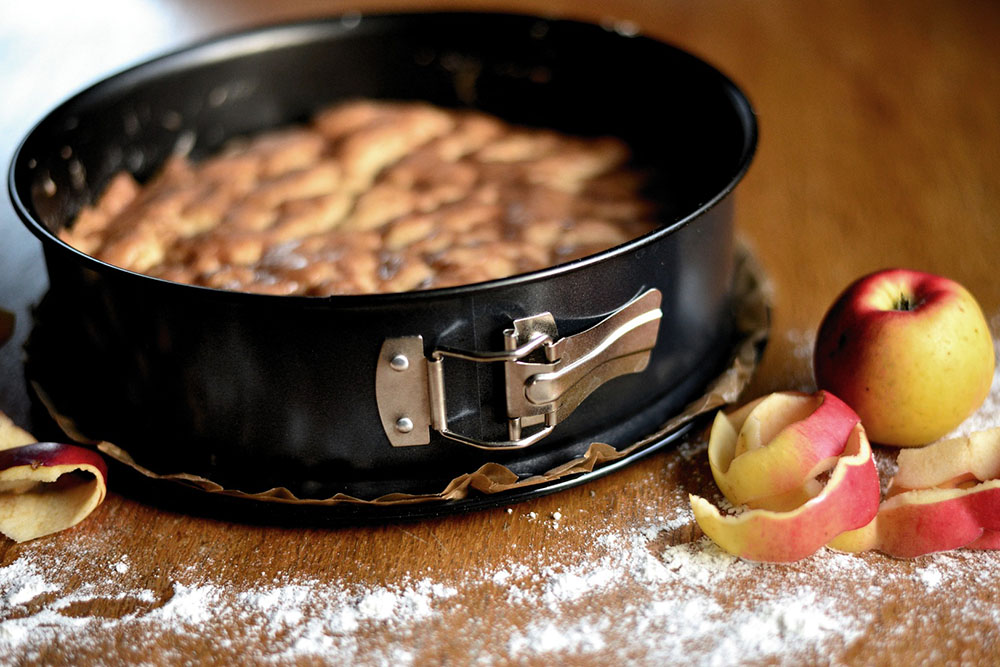
Generously grease inside of pan with solid vegetable shortening. Use pastry brush to spread shortening evenly, making sure all inside surfaces are well covered. Dust with flour, tap out excess. If shiny spots remain, touch up with more shortening and flour, or use vegetable pan spray.
Position pans as near to center of oven as possible. Pans should not touch sides of oven or each other.
Test your cakes for doneness while they’re still in the oven. Because of differences in individual oven controls, be sure to test your cake for doneness according to package or recipe directions. Cake is done when the sides shrink slightly away from the pan and a cake tester or toothpick inserted in center comes out clean.
Cool cake in pan 10 - 15 minutes before loosening the edge and turning it out onto a wired rack to cool.
To remove cake easily from pan, place double thickness paper towel over wire rack. The towel prevents the wire bars from breaking the crust or leaving imprints on top of cake. A clean oven rack or refrigerator shelf can be used for larger layers. Place covered rack over top of cake. Invert cake and rack at least one hour before decorating. Then brush loose crumbs off cake.
Frosting:
Chill the cake between the filling and the frosting. The cake will be much easier to work with.
Apply a thin layer of frosting to the cake then refrigerate until it is set before applying the final, heavier layer of frosting. This will seal in the crumbs, ensuring a clean final appearance.
When good cakes go bad
You thought you had a good cake, but lately he’s been hanging out with the wrong crowd - some tough cookies. Soon he’s staying out late and coming home reeking of alcohol-based vanilla extract. Before you know it your angel ( food) is on a one way street to culinary reform school.
It’s tough when good cakes go bad — and here are some of the most common reasons:
In General:
If the cake rose unevenly in the oven:
The flour was not blended sufficiently into the main mixture.
The temperature inside the oven was uneven.
The oven temperature was too high.
If the batter overflowed the pans:
Make sure you used the right size pan. The uncooked mixture should fill the pan by no more than two-thirds.
Cakes That Use Separately-beaten Egg Whites And Yolks
If the cake is dense and heavy:
The eggs were too small. Always use large eggs when baking.
Insufficient air was whisked into the egg and sugar mixture.
The flour was not folded in gently. Always mix in the flour at the lowest speed.
The melted butter was too hot when added, causing it to sink down through the whisked foam.
The oven temperature was too low.
If the top of the cake dropped:
The oven temperature was too hot.
The cake was not cooked long enough.
The oven door was opened too soon, which created a draft.
Cakes That Use Creamed Butter And Sugar Mixtures
If the batter curdles and separates:
The ingredients were not at room temperature.
The butter and sugar were not creamed together well enough before adding the eggs.
The eggs were added too quickly.
If the cake’s texture is too heavy:
The butter, sugar and eggs were not beaten together long enough.
The flour was beaten at too high a speed.
Too much flour was added to the creamed mixture.
The oven temperature was not hot enough.
If the top of the cake peaks and cracks:
The oven temperature was too hot, causing the outside of the cake to bake and form a crust too quickly. As the mixture in the center of the cake continued to cook and rise, it burst up through the top of the cake.
The cake wasn’t baked on the center rack of the oven.
If raisins, dried fruit and nuts sunk to the bottom:
The pieces of fruit were too large and too heavy.
The sugary syrup on the outside of the fruit was not washed off- this caused the pieces of fruit to slide through the mixture as it heated.
The washed and dried fruit was not dusted with flour before being added to the mixture.
The cake mixture was over beaten or was too wet so it could not hold the fruit in place.
The oven temperature was too low, causing the mixture to melt before it set to hold the fruit in place.
Archive can be found here
Some of our recent posts: